
THE NON-FIGURATIVE MYTHOLOGEMS BY VITALY KOPACHEV
"Every work of art is a child of its time, and often becomes the mother of our feelings".
Wassily Kandinsky
The creation of mythological and artistic images has always been and remains one of the main ways for a person to comprehend the surrounding reality. The collective unconscious stores layers of ancient myths and strong associations, shrouding them with new layers. On the basis of primary essential myths in situations where existential experience is highlighted as a value and fixed in symbolic form, mythologems are formed as stable figures of collective consciousness. They are embodied in a certain symbolic form and are unmistakably recognized by representatives of a particular culture. Since any mythologem exists in human perception, it is through perception that it is capable of incorporating any object as part of its own content, provided the object in question falls under certain formal criteria of the original mythologem.
The term "mythologem" itself has Greek roots, meaning "story, legend, thought, reason." This includes plots, scenes and images characterized by globality and universality. Human mentality, as such, functions in the form of long-term thought patterns, axiological attitudes and skills that extend far beyond the rational and determine a person’s state of consciousness and behavior. There are mythologems of light and darkness, good and evil, top and bottom, love and hate, heat and cold, west and east, and many others. In literature, a mythologem is often called a mythological motif, deliberately used in the world of fiction. As for painting, there are art images that play the role of mythologems, with their endless semantic facets that make them relevant at all times.
In relation to the work of Vitaly Kopachev, we speak of mythologems as art images of non-objective painting, which are rooted in the previous history of art. They provide the basis for understanding the existing art as well as for creating new art because of their ambivalent nature: on the one hand, a mythologem is completed, and on the other, it may lead to creating new messages . In addition, these art images are semantically loaded not only in terms of purely pictorial and expressive means of artistic language as such, but also as an abstract display of verbal and sound constructions. The latter phenomenon can be seen from the titles of Kopachev’s works. His "noises", "half-shadows", "screen adaptations" and other allusions actually tell and show something that cannot leave the viewer indifferent, even if he does not quite understand this language of dots, lines and colors.
And yet, in order to "read" the messages that Vitaly Kopachev strives to get across, one should master the language in which they are written, or at the very least familiarize themselves with it. This language is as much Russian as it is international; it is new, yet ancient. "Kopachev's works of different years resemble unhurried conversations with ancient masters who resorted to ornaments and geometrical forms in order to find some foothold in an unpredictable world. It is as if he is conversing with Homer and ancient philosophers about the sensually perceptible cosmos. But the most exciting conversations are, undoubtedly, those held with Vasily Kandinsky, who, like the ancient thinkers, acutely felt the pulsation of the universe and sought a painting technique able to depict it” [1]. The same goes for his conversations with Jackson Pollock, who desperately sought his own way to communicate with the viewer and finally found it in the movements of his own body, thus becoming the founder of action painting.
Nevertheless, Vitaly Kopachev's artistic language is absolutely unique and self-sufficient, it can never be reduced to any existing ones. The artist himself says that abstract forms began to interest him very early, despite his traditional artistic education deeply rooted in realistic drawing and composition. As a student, he became closely acquainted with folk art and peasant textile art and realized the “charm of the formal.” Sifting through museum storerooms and making a huge number of copies of painting on trunks, spinning wheels and fabric, the artist understood abstract form-making from within [2].
Unlike the abstract artists of the first half of the 20th century, whose works illustrated some theoretical points expressed in manifestos, proclamations, books and letters, Vitaly Kopachev creates his paintings outside the verbal space. Like other representatives of the “new abstraction,” he “talks” about the social, historical and political without resorting to visualization of thought; rather, he appeals to the feelings of the viewer and their subconscious. The artist believes that “the art of the future is the art of ideas revealed by the vibrations of those structures that the artist has revealed on the canvas of his thoughts, therefore abstraction, as a departure from the material, will invite us to look into the depths of human conditions, the laws of psychology and the laws of life”
Kopachev does not consciously limit or influence the viewers' thoughts in any way - in most cases his works do not even have a title. His paintings combine different worlds and represent a mix of feelings that overwhelm us daily. This virtuoso interweaving of emotions and impressions, expressed on canvas, is formed from various factors that cannot be reduced to a material component. And we perceive these frequencies with our “sixth sense”, peering into the endless struggle of various vibrating structures, forms and signs. Kopachev’s painting looks intentionally abstract, it is devoid of words and meanings, but in it one can read encrypted mythologems both from the world of art itself and from human existence.
These mythologems are innate to us; yet they keep offering new facets of meaning, which is realized (or formed anew) after it has passed through the “sieve” of our feelings and emotions. “The artist combines opposites, creates “impossible connections” of spontaneity and calculation, freedom and control; he weighs all the "pros " and "cons " aiming to find the balance of complexity and simplicity. As a result, the painting generates a single impulse that is transmitted to the viewer at the level of pure visual perception. Thus, the works become objects that affect the living space of a modern person. By instilling a unique impulse of creation into the painting and filling it with the original meaning, Vitaly Kopachev aims to express the patterns hidden in the plasticity of forms. In his abstract paintings, similar to living organisms, he strives to reveal to the viewer the materiality of emotions and the physical tangibility of sensuality”,- this is how his friend and colleague Andrey Volkov writes about Kopachev’s works in the annotation for the exhibition “Pulsation,” which took place in March 2017 at the Omelchenko Gallery[3].
Undoubtedly, “the materiality of emotions and the physical tangibility of sensuality” manifests itself in each viewer in their own way. Yet, when it comes to mythologems, being a product of the collective unconscious, they illustrate how basic mental settings are reflected in the artistic vision of the world. These images represent a form of shared collective emotional experience and interpretation of reality and are considered as independent phenomena. By their nature, mythologems are syncretic and harmonious, lacking boundaries between the objective and subjective, the natural and the supernatural. One may not fully recognize them, but they cannot be rejected either, since their existence does not depend on the individual person.
Thus, one of the works by Vitaly Kopachev from the series "Ghostly Goals", using the artistic language of color, lines, spots, rhythm and texture of brushstrokes, evokes the mythologem of loneliness. This feeling has captivated the greatest minds of humanity since ancient times, who tried to comprehend this phenomenon and find its origins. Man comes into this world alone and leaves it alone, too. Between these moments, his life flies by like a stormy stream of emotions in a whirlpool of events. However, sooner or later, each of us is forced to stop and look inside ourselves. Everything around us is still seething and boiling, but a person who dares to look their transcendental loneliness in the face will never be the same again. At this moment, everything happening around becomes distant and, by and large, unimportant, although still dear and familiar.
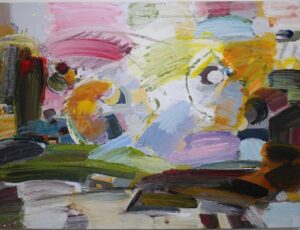
Series "Ghostly Goals", 2021 Canvas, acrylic, 90x120 LEVANOVA COLLECTION
The colours of the canvas seem bright, but they are not the yellow that tells us about joy and happiness, and the earthy green does not calm us down at all, but rather, on the contrary, instills anxiety, which is only intensified by purple, black and brown. To top it all off, beige, grey-white and pale lilac sing their sad song, and sharp strokes in different directions symbolize the chaos and vanity of the surrounding world. This environment only intensifies the feeling of loneliness and burning, all-consuming melancholy, which is frightening in its inexplicability. However, the hard, dark vertical spots give reason to think that the man will withstand this struggle with himself. In addition, Moira has already woven her thread and is ready to throw it on him, and he has already realized his fate, accepted it and, thus, gained peace and confidence in his strength. His pain is drowned in the hum of the universe, giving rise to a feeling of closeness and kinship with others, the fear of being judged and misunderstood disappears, and in its place come freedom, peace and a sense of happiness.
A special place in human consciousness is occupied by the mythologeme of the world ocean, which is one of the fundamental elements of the universe. In the cosmogony of many peoples, water marks the beginning and end of all things, combining the motive of the origin of life and the motive of the flood. The ambivalence of the element of water allows us to metaphorically depict life as a whirlpool and swirl on the surface of the water, and death is like sinking to the bottom or reaching the shore, that is, finding peace in another life. In the mythopoetic tradition, the world ocean "as a primary substance in chaotic motion is everywhere. It is boundless and disordered, dangerous and terrible, but at the same time constant, self-sufficient and beautiful.
In one of his songs, Maldoror addresses the majestic ancient Ocean, praising its wisdom and incomparable virtues, against which man appears smug and insignificant and proud. However, unlike the isolated existence of the inhabitants of the Ocean, which has natural causes, people are separated from each other by envy and hypocrisy. "O ancient Ocean, the fish tribes that inhabit your waves have not sworn brotherly love to each other. Each species lives by itself... the difference in habits and sizes explains this quite well. People also live separately, but no natural causes prompt them to do so..."[4].
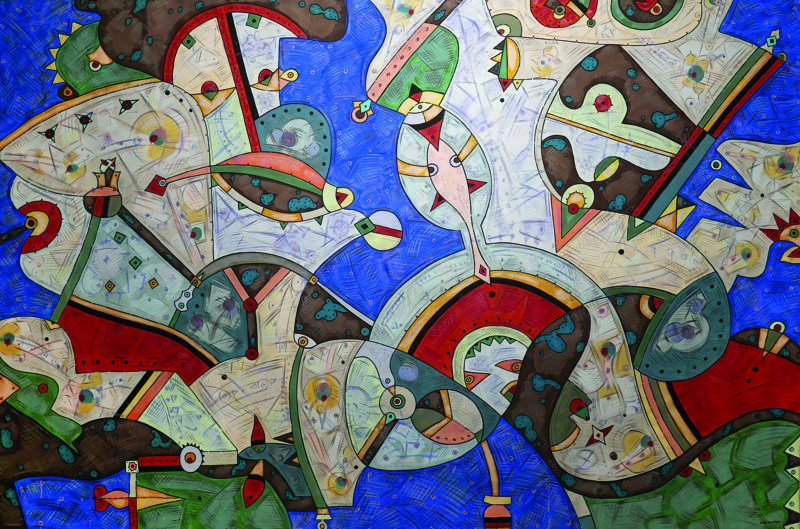
"Maldoror", 2023 Canvas, acrylic, 200x300 Property of the author
Looking at Kopachev's canvas "Maldoror" measuring three by two meters, the viewer physically feels the power and depth of the Ocean, which are commensurate only with the will and strength of the one who could create such "immensity". And yet, no matter how great the depths of the ancient Ocean, Maldoror claims that the human heart is incomparably deeper. It is full of an inescapable longing for eternity, which nothing can satisfy, since eternity is the lot of God. Only the immortal waters of the ancient Ocean can alleviate this fate. Restless and doomed to loneliness, with a mad truth on his lips, Maldoror realizes his lonely lot and wants to die in the middle of the Ocean, bowing before it and wishing for man to find at least a shadow of its greatness.
It should be said that the concept of a mythologeme is used not only to designate the universality of consciousness, but also to build a strategy, during the implementation of which it becomes possible to turn to the activity of consciousness, formatting the reality of the objective world according to its own laws. The symbols included in the mythologeme form a symbolic complex or system, within which the symbols relate to each other through mutual references. Thus, individual compositional elements on the canvases of Vitaly Kopachev may seem unrecognizable, and the motifs used - random. However, perceived in their artistic unity, they work with the subconscious of the viewers in the most powerful way, giving rise to questions to which one must seek answers within oneself.
In addition to figurative mythologemes that evoke a wide variety of feelings and emotions, Vitaly Kopachev’s work also contains purely artistic mythologemes that are rooted in the history of painting and pave the way for future fine art. All these “dots and lines on a plane” coupled with color spots represent a clearly expressed harmony of proportions, tones, rhythms and materials, which pierces the viewer with its powerful energy to the very heart. The color relationships, textures and divisions of the painting into verticals, horizontals and diagonals are capable of causing very deep experiences in themselves. Since the number of colors and forms is unlimited, their combinations are also unlimited, and therefore the possibilities of influence. To form this effect, the artist must organize the interaction between all elements of the painting and combine opposites: spontaneity and calculation, freedom and control, complexity and simplicity. Only in this way will the work be able to generate a single impulse, which the viewer perceives at the level of visual perception and which will penetrate his consciousness through the unconscious.
Standing before Kopachev’s monumental work “Stages of Involvement,” consisting of four enormous canvases, each of which could be an independent work, it is impossible not to wonder what involvement is being discussed, and why there are four of these stages, and not three or five, for example. And we begin to peer into the endless struggle and clash of various vibrating structures, forms, and signs,creeping or penetrating into each other. “On canvases it is interesting to trace the movement of forms, the emergence of conflicts and their resolution in two-dimensional flat painting, to discover color zones that have an illusory depth. It can be assumed that Kopachev strives to establish a new rationality, synthesizes the searches of representatives of informal art and constructivists. But it can also be considered that he is developing a methodology of irrationality. In all cases, what is attractive is that the works are permeated with powerful dynamics"[5].
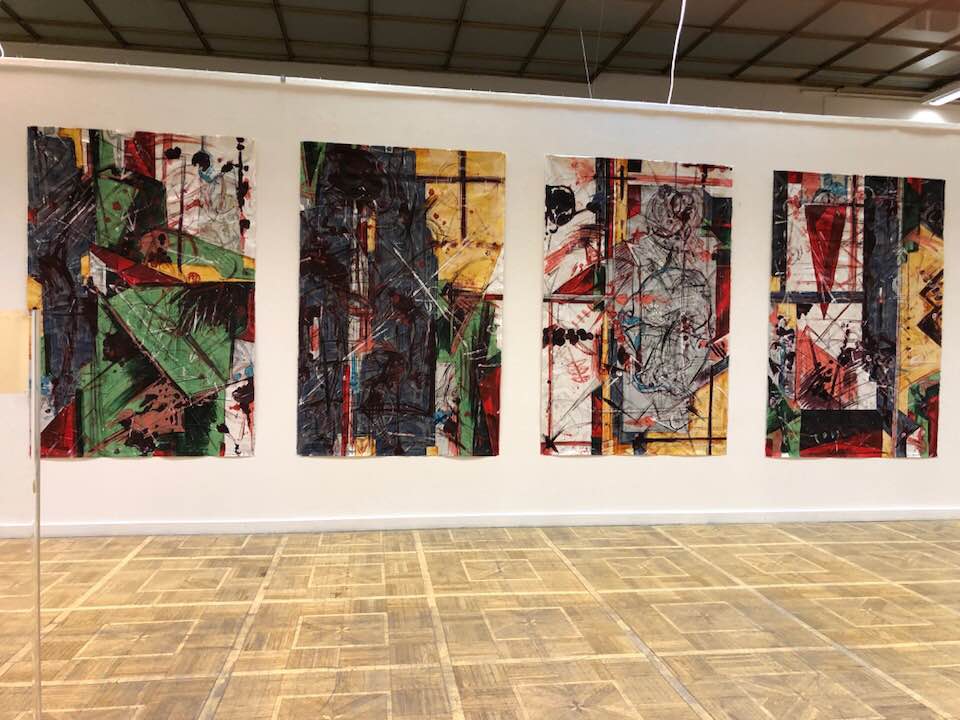
"Stages of Involvement", 2012 Canvas, acrylic, 250x630 LEVANOVA COLLECTION
With his work, Vitaly Kopachev reveals to the viewer the materiality of emotions and the physical tangibility of sensuality, expressing patterns hidden in the plasticity of forms. His abstract compositions are similar to living organisms that do not have a strictly defined structure with clearly defined main and secondary. Lines and forms are born under the influence of a psychological impulse and are arranged on the plane in a kinetic order, coming to life and colliding with each other. In the pool of our perception, individual forms and associatively recognizable elements connect the visible world with that life that is directed into the depths of personal being, which is not subject to being completely defined by word or form. "If we close our eyes, we find ourselves in a world of abstraction: spots, traces of light movement on the retina. What we see before we are born, inside our mother, is an abstraction. The darkness, when we close our eyes, easily becomes for us not a flat screen, but a depth in which we live dreams... In complete or almost complete darkness, we necessarily draw what we do not see.We find ourselves in the visible space of our own unconscious. Perhaps we are returning to prenatal vision, to which objects and their outlines have not yet appeared”[6].
Complex visual structures on the canvases of Vitaly Kopachev charge viewers and the surrounding space with their powerful and absolutely unique energy, transporting the viewer to a completely different world. In this world, you can "hear" colors and "see" sounds, synchronize with the rhythm or dissolve in silence. This world is quite unique, but extremely convincing and infinitely profound. Like any work of art, Kopachev's works exist not only in the atmosphere of previous cultural layers, but also in the context of today. In the words of Kandinsky, the artist moves from "the world as a fact of judgment" to "the world as a fact outside of judgment." Lying on the canvas, the lines and color spots form a single space and open to the viewers a special world of the artist's inner space. The images, feelings and emotions of Vitaly Kopachev's personal existence are based on genuine experience and are open to everyone who is ready to awaken their subconscious and seek answers to the main questions within themselves.
LIST OF REFERENCES
1. Kulpina Yu. Breath of Space // Dialogue of Arts. 2014. No. 4. P. 84
2. Yavorsky V. Earthly Life of Vitaly Kopachev // Cultural Trend. 2017, November-December. P. 39-40
3. Volkov A. Vitaly Kopachev "Pulsation" // Access mode: https://www.omelchenkogallery.com/vitalij-kopachev-pulsaciya
4. Lautréamont. Songs of Maldoror. Moscow, 2021. Page 19
5. Victoria Khan-Magomedova. Struggle and Fire // Dialogue of Arts. 2013. No. 3. Page 137 6. Pavel Otdelnov. That Which Is Difficult to Define // Dialogue of Arts. 2022. No. 6. Page 25