
FIVE ALLEGORY OF THE NEW MOSKOVITES
“А nothingness of void, a neverland of otherness” Velimir Khlebnikov
Abstracts
This article deals with one of the directions of Russian modern art, which showcases the development of contemporary culture. A detailed account of the New Muscovites Project can be considered as a foundation for further research.
Keywords
Contemporary art, Moscow school of painting, Russian art, art theory, history of painting, Moscow artists, contemporary artists.
Why “allegory” and who are the “New Muscovites”? Let's start with the second question. The term “Muscovites” has long been used in relation to citizens of The Grand Principality of Moscow, or Muscovy. Muscovy was the original Latin name of Moscow, which was later transferred into a number of Western European states to the unified Russian state formed around Moscow under the rule of Ivan III. In the case of the New Muscovites Project, however, the focus is not so much on the origin of the artists, but on their unique artistic approaches characteristic of the Moscow Art School. The word “New” refers to the fact that while the artists follow in the Moscow artistic traditions, they strive to find new means of artistic expression reflecting the burning issues of our time. The term “Muscovites”, though obsolete these days, points to the origin of the project members.
Before talking about allegories as such, let us focus on the Moscow school of painting, in which allegory has always been of great importance. Starting from the late 19th century several generations of Moscow painters tended to rely on a wide range of traditions of the Moscow School of Painting, Sculpture and Architecture. Throughout 85 years of its existence (1833 - 1918), the School was alma mater for many artists who started as students there (and some even became tutors later). Of course, art in Moscow had arisen much earlier, but it was within this period that the most significant names of artists of the realistic movement gained recognition, and it was this School that embodied Moscow in the never-ending rivalry between the two major Russian art schools: that of Moscow and that of St. Petersburg.
The Moscow School differed favorably from the St. Petersburg Academy in its greater democracy, freedom of artistic creativity and openness to new, advanced trends. Moscow artists, although they lived on a tight budget and lacked state support, still managed to work in a more lively atmosphere, not being limited in their quest by academic constraints. And although “there was a lot of amateurishness and imperfection in the methodology of teaching at the School, especially during the early period”, from the very beginning it was dominated by “an atmosphere of great love for art, interest in public life, camaraderie between teachers and students and mutual involvement in their joint efforts”, which “added authority to the School and its students and contributed to their success”.
All this greatly affected the nature of the work of Moscow artists: expression and emotionality, rebellion and genuine reproduction of life became the hallmarks of the Moscow school of painting, and its roots in icon painting and closeness to ornament and decor gave it its inimitable picturesqueness, deep symbolism and a distinctive blend of authenticity and beauty. “Since the time of Perov, the right tone has been set. Lately there has been a lot of artistry. This young, simple and unique school exuded life! ...now it is becoming more and more obvious that Moscow will once again gather the Russian lands. In all the most important manifestations of Russian life, Moscow expresses itself in a gigantic manner, inaccessible to other cultural centers of our fatherland; they have to settle for merely imitating it, and on a more modest scale. Yes, Moscow will certainly come into its own in the school of painting as well...”
In 1918, the Moscow Art School ceased to exist as the School of Painting, Sculpture and Architecture and was first transformed into VKHUTEMAS, on the basis of which the Moscow Art Institute was later formed. V.I. Surikov, who created a real galaxy of Moscow artists of the Soviet era, who made a significant contribution to the Russian fine art heritage. They set the main creative trends in the fine arts of this period that were rooted in the democratic traditions of progressive Moscow art of the 19th century. The role of VKHUTEMAS in Russian art and design is yet to be explored and described in detail as despite its relatively short existence, it left behind a significant legacy.
Moscow art has always been closely connected with real life and human experiences. During the Great Patriotic War, many Moscow artists volunteered for frontline duty, while others actively participated in propaganda work, creating posters and sharp political satire. In the 60s, the social changes taking place in our country gave rise to an active movement in the fine arts among the youth of that time. It was grounded in an appeal to the brutal romanticism of the post-war years, and a number of artists working in this style made a name for themselves. In the 80s, along with easel painting, monumental art flourished as well as decorative and applied art, scenography, design, applied graphics and posters. And in all these areas, Moscow artists largely set new trends and had a considerable influence on the development of the arts far beyond the capital. Along with official art, Moscow conceptualism and Moscow actionism arose at this time - brands that, unlike the Russian avant-garde, are better known abroad than in the vast Motherland.
The events of the 90s turned the life of the entire country upside down, and Moscow artists were no exception: the quest for identity “on the world art scene coexisted in the 90s with reflections on the possibility of art as such and the search for its alternative forms, united by the conceptual approach to the emerging political art ". Compared to the conservative artists who defended the position of preserving the autonomy of art, the artistic statements of Moscow actionists looked like radical and aggressive attacks. Actionists chose to renounce the perceived role of artists as producers of “supervalues” as well as their ambitions to hold a special place in the social hierarchy. The unique place of contemporary art as an intersection of philosophy, politics and visuality has changed the Moscow artistic landscape, giving rise not so much to new movements or creative unions, but to individualism and self-expression. However, even under these conditions, the Moscow art school retained its originality.
The 2000s still retained “the energy of change, post-shock neuroticism, openness to all things new and that amusing naivety with which many of us expected if not accomplishments then at least an unknown bright future from contemporary art”. In the 2010s, however, fatigue set in: from institutional routine, from the endless flurry of festivals - and from instability, too. The previous decade began with the success of artists following their own path in art, outside of groups and movements, but then it turned out that being a loner was no longer fashionable. The current Moscow art world is diverse and eclectic. Along with successful individual artists, various art galleries are actively trying to function in it, promoting artists under their master brand, making their decisions based on the personal preferences of the gallery owners or the sales potential of the works.
In this regard, the NewMuscovites Art Group is a unique project that unites independent contemporary artists who are representatives of the Moscow art school in the broader sense. Two of them, Vladimir Ozerov and Yana Gavrilkevich, are graduates of the Moscow State Academic Art Surikov Institute, that, as already mentioned, is the direct successor of the Moscow School of Painting, Sculpture and Architecture. Vitaly Kopachev and Anatoly Pelevin, in turn, graduated from the Moscow Institute of Technology, where they received their art education ten years apart. Antonina Garasko studied drawing and painting at the Moscow Pedagogical State University and is currently a teacher at the Surikov Institute. They are all very different in their vision of modernity, the artistic techniques and styles they use, but their work is based on the underlying principles that have characterized the Moscow school of painting since the very beginning. And the allegory as a means to represent their work is an attempt to show the unity of their creative roots
We have already pointed out that Moscow art is rooted in Russian icon painting with all that it implies. Unfortunately, Moscow frescoes and icons of the 12th-13th centuries were irrevocably lost, but the works of the early 14th century - the icon “Boris and Gleb” and the miniature of the so-called Siya Book of Gospels - show bright open colors and graphic expressiveness of flat silhouettes. In another artifact of the mid-14th century, the icon “The Life of St Nicholas”, “in its decisively loose manner of painting and its very special psychological structure, one can feel the hand of a true master who is not used to following in others’ footsteps”. The description sounds familiar, doesn’t it? These early icons already showed originality as they looked unbounded and unhindered, effortless yet charged with emotions; they showed life-like quality . All these features have been peculiar to Moscow painting since its early days. Even the subsequent European influence, from Byzantine painters to the movements of the 20th century, did not diminish this originality that stems from the style of the Moscow icon “with its light graceful figures, with its dynamic compositions, with its bold color combinations.”
Moving on to a more precise description of the allegorical works of the New Muscovites, it should be noted that it is a person with his experiences, feelings and passions that is at the core of any type of art. After all, art itself is nothing more than exploration carried out through the artist’s emotions and imagination and expressed in his works. And it is the image of a person as both the Creator and the Creation that we see expressed by Vladimir Ozerov on canvas in “The Solovetsky Stone”. (p. 1). The painting was created at the famous Solovetsky Monastery. It can be viewed as a vivid illustration of the famous “Omnipotence paradox” that asks "Could God create a stone so heavy that even He could not lift it?" The whole point is that if God can create such a stone, then He is not omnipotent, since He cannot move it from its place. Thus, the creation of such a stone is the limit of divine omnipotence. But if God cannot create such a stone, then He is not omnipotent either, since the creation of some things is beyond His power. The “Omnipotence paradox” is one of the many paradoxes associated with various interpretations of omnipotence. Essentially, they ponder whether an omnipotent being can set tasks impossible for himself or whether he can make logically contradictory verbal constructions, such as, for example, the “square circle”, materialize in objective reality.
The answer to the “Omnipotence paradox” depends on what philosophical stand the person takes or/and the religious beliefs he holds. A believer will never doubt God’s omnipotence and will say that God is so omnipotent that He can afford to not be omnipotent. A physicist will point out that the wording of the paradox is subject to criticism as the terms used are inaccurate. For example, the weight of an object is determined by the force of the local gravitational field. A sophist will argue that the paradox inevitably contains a logical contradiction: the terms “lift” and “stone” belong to the real world. Therefore, God can create a stone that no one in this world can lift but Him, since He is not part of this world.
Looking at the work of Vladimir Ozerov, “The Solovetsky Stone,” we feel that neither the weight of the stone nor the force of its bindings can prevent it from lifting itself in case no one else can lift it. The stone lies on the ground, entangled in its worldly connections and wounded by its passions, but what torments the stone is also what lifts it up. It is the joyful turquoise color used for the bindings, the wounds and the vertical stripes symbolizing the path “up” that speaks of it. This path is very difficult, but a person is born with a yearning for light and a love of beauty, even though life is often full of ordeals that leave deep wounds in one’s soul. Yet, these wounds are the key to reaching enlightenment and saving one’s soul - and who knows more about it then the monks, including those in the Solovetsky Monastery?
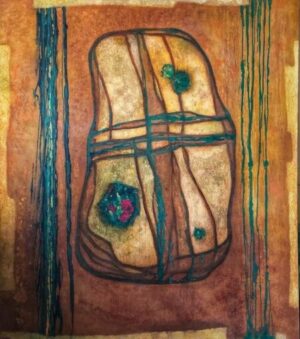
(p. 1) Vladimir Ozerov. Solovetsky stone. Canvas. Acrylic. 130x150 cm. Private collection.
The question about the origin of man and the universe as a whole is one of those to which humanity has been seeking an answer throughout its existence. What came first: the chicken or the egg? Until now, no one has given a convincing answer to this simple riddle. Antonina Garasko’s work is called “The Sun,” although at first glance it may seem that it is just a fried egg. (p. 2) However, if we look at the canvas more closely, then beyond the edges of the egg white we begin to make out endless blue-black Space, in which the lonely Sun shines brightly, giving light, warmth and sustenance to all life on Earth. Is it an Egg-sun or the Sun-egg? Both can breed life and give strength, and yet both can also kill
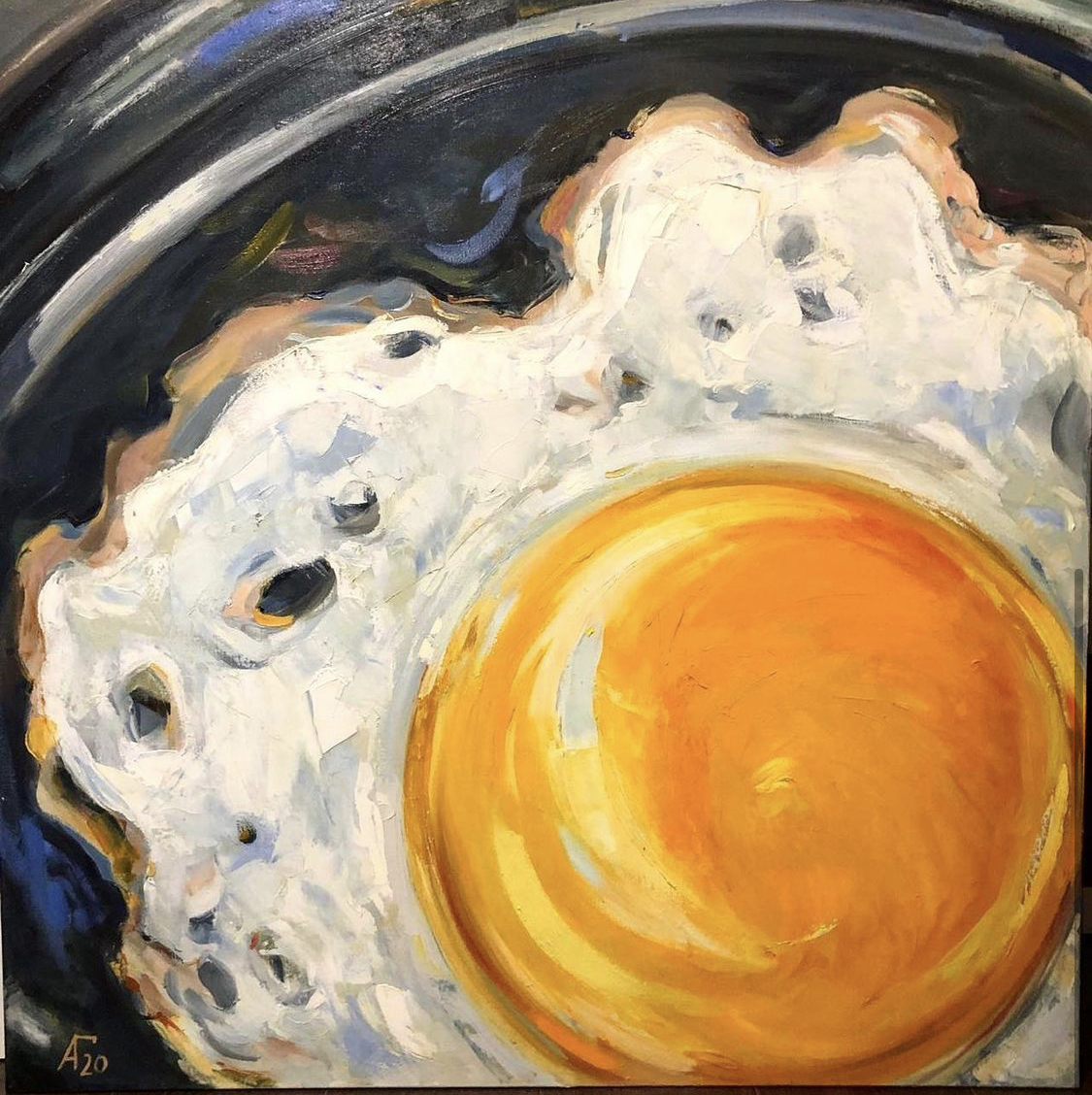
(p. 2) Antonina Garasko. Sun. Canvas. Oil. 100x100 cm. Private collection.
In Egyptian mythology, the egg represents the awakening life and is a symbol of immortality. The egg hides the great secret of the creation of the world and eternal life. The Indian Vedas tell of a golden egg from which Brahma hatched. The legends and myths of many countries of the ancient East say that there was a time when Chaos reigned in the Universe. Chaos was located in a huge egg in which all forms of life were hidden. Then the shell of the egg was warmed by divine fire, and the mythical creator Panu was born from the egg. The Creator connected the weightless Sky with the solid Earth; He created space, wind, the sun, the moon, clouds, thunder and lightning.
In Egyptian mythology, the egg represents the awakening life and is a symbol of immortality. The egg hides the great secret of the creation of the world and eternal life. The Indian Vedas tell of a golden egg from which Brahma hatched. The legends and myths of many countries of the ancient East say that there was a time when Chaos reigned in the Universe. Chaos was located in a huge egg in which all forms of life were hidden. Then the shell of the egg was warmed by divine fire, and the mythical creator Panu was born from the egg. The Creator connected the weightless Sky with the solid Earth; He created space, wind, the sun, the moon, clouds, thunder and lightning.
Human life is tightly bound with creativity. It is creativity with its emotional, imaginative and artistic reflection that elevates a person above mundane life and sets him apart from the rest of the animal world. This is what “The Crown” by Anatoly Pelevin is about. (p. 3). The work is based on the famous image of a crown by Jean-Michel Basquiat, who created his “Crown” in 1983 in the style of neo-expressionism and street art. He used ink and acrylic paints on paper covered with sheets of notes and sketches. The crown is the most popular symbol in Basquiat’s works as it represents his journey from a tramp to a famous artist. It also symbolizes the high intellectual and spiritual merits of a man. Being depicted on its own, unattached to any person, it becomes a sign of specialness and greatness.
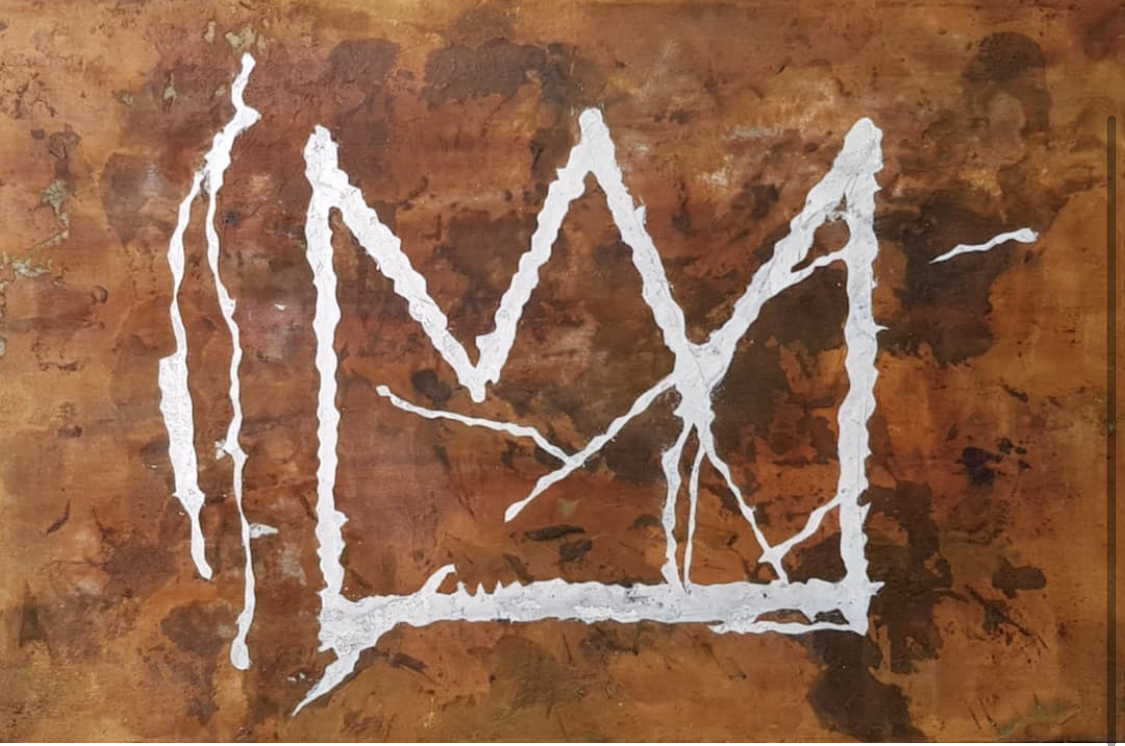
(p. 3) Anatoly Pelevin. Crown. Canvas. Mixed technique. 75x45 cm. Private collection.
Anatoly Pelevin depicted the Crown against a rusty background as a symbol of modern times, in which people strive to become celebrities. On the one hand, this is the scourge of our days that brings forth many unpleasant experiences for professionals from various walks of life. In the digital world, anyone can become famous quickly without making much effort. The trick is to resonate with the audience. On the other hand, everyone has the right to their fifteen minutes of fame if they put all their heart into what they do, if they love it and strive for perfection. Pelevin believes that absolutely anyone can become a “king” in their field and remain such in eternity, even when everything around collapses and goes rusty. At the same time, the ironic and primitive way in which the crown is painted reminds us that we should not take the glory and status of the king too seriously.
Yana Gavrilkevich’s work “The Garden” is an allegory of the happiness that a person lost upon leaving the Garden of Eden, and which he yearns for throughout his life. (p. 4). We understand that the canvas depicts happiness by looking at the colors used: yellow, red, green, blue and white are commonly associated with it. According to psychophysiologists, each of us feels colors on an intuitive level. What ancient color therapists only guessed about, modern medicine knows for a fact: a color reflected in the iris of the eye affects the vital functions of all our organs. It changes the physiological state of a person, affecting his nervous system and causing hormonal changes in the body. The very manner in which the work is created does not evoke the feeling of anxiety even though there are diagonal lines in it; it is a relaxed stroll along a familiar path with no disasters looming ahead.
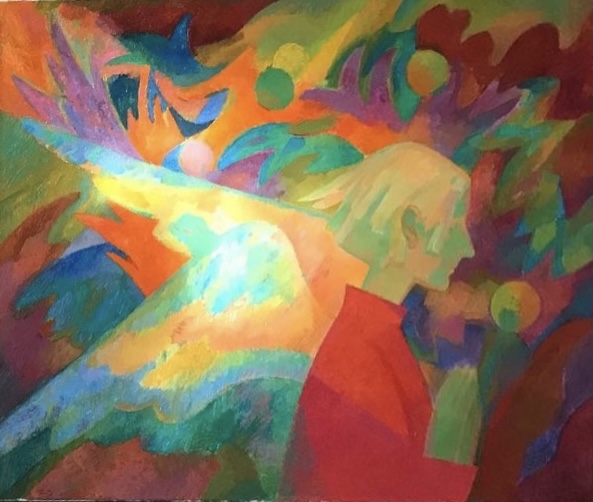
(p. 4) Yana Gavrilkevich. Garden. Canvas. Oil. 90x60 cm. Private collection.
The apples and an Angel with luminous colored wings clad in a red robe tell us about the Garden of Eden as the quintessence of happiness. Everything is suffused with peace and joy, and the viewer starts to share the emotion. Red and yellow bring a feeling of coziness, comfort, relaxation and equanimity; they create an atmosphere of closeness and emotional attraction. In turn, blue and green relieve tension and stress, creating a feeling of harmony both within a person and in his relationships with the outside world. Isn’t this an idea of the happiness of a modern person, exhausted by endless competition, snowed under an abundance of information, plagued by cursory contacts, and yet isolated from nature and his own kind?
IIt is about the loneliness of modern man that Vitaly Kopachev’s work from the “Phantom Goals” series tells us. (p. 5). “Everything is ghostly in this raging world, there is only a moment - hold on to it,” a famous Soviet song says. A person comes into this world alone and leaves it alone. Between these moments his life flies by like a stormy stream of emotions and a whirlpool of events. Sooner or later, each of us is forced to stop and look inside ourselves. Everything around still keeps whirling, but the person who dares to face his transcendental loneliness will never be the same. At this moment, what is happening around becomes distant and unimportant, although still dear and familiar.
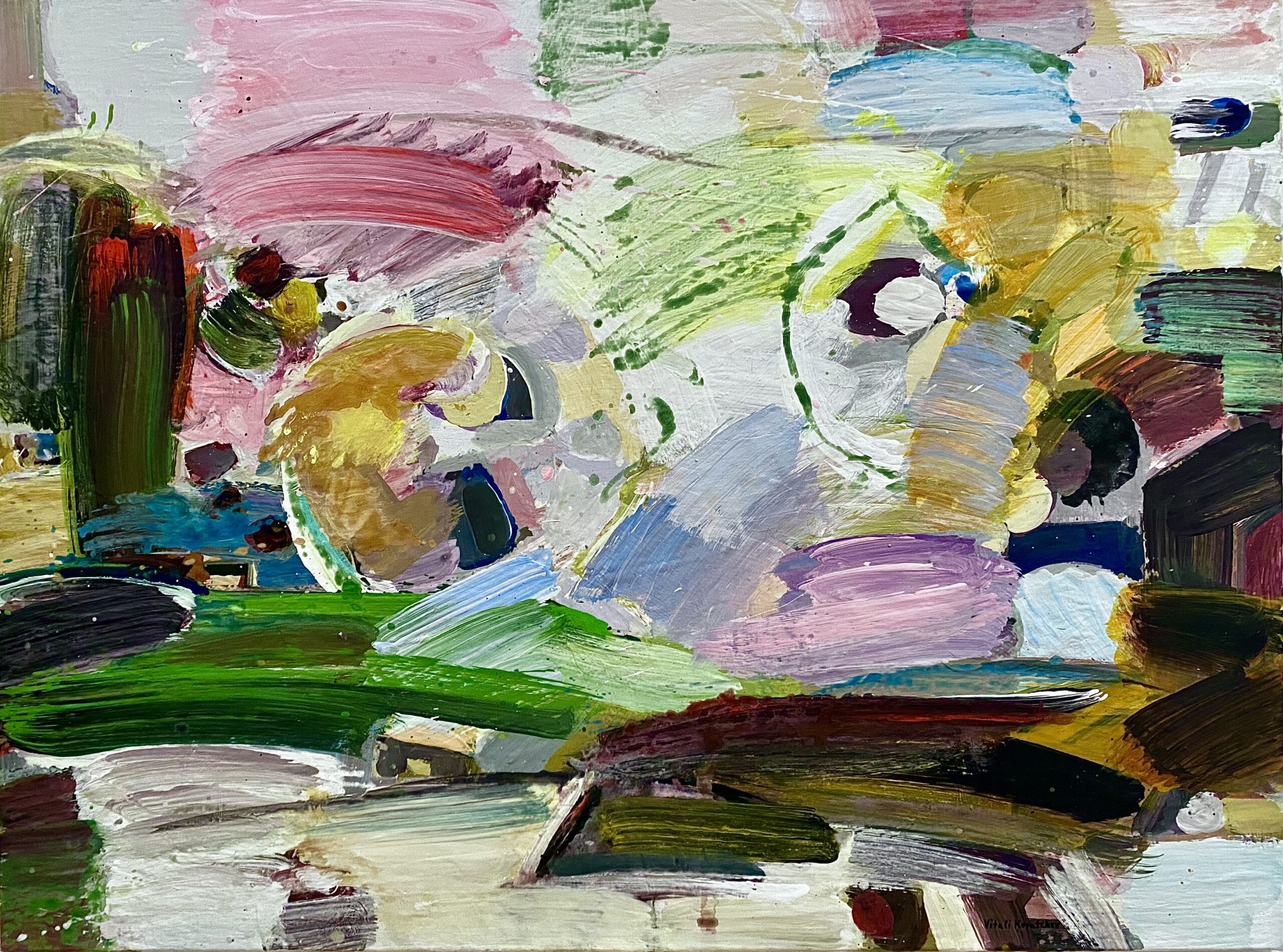
(p. 5) Vitaly Kopachev. Series "Phantom Targets". Canvas. Mixed technique. 120x80 cm. Private collection.
The colors of the canvas also appear bright, but how strikingly different their language is from the previous work. This is definitely not the yellow that tells us about joy and happiness, and the earthy green does not soothe us, but rather instills anxiety, which is only intensified by the purple, black and brown hues. To top it all off, beige, gray-white and pale lilac sing their sad song, and the sharp strokes in different directions speak of confusion and chaos in the soul of a person who has realized that he is alone. However, the hard dark vertical spots give reason to think that a person will resist, accept his path and walk along it to the end, to where the stones are light, where life is endless and where everyone walking in the Garden of Eden has their own crown - a crown worn by a happy soul.
Bibliography
1. Dmitrieva N., Moscow School of Painting, Sculpture and Architecture. M., 1951. 2. Lazarev V.N., Moscow school of icon painting. M., 1971. 3. Podobedova O.I., Moscow school of painting under Ivan IV. M., 1972. 4. Repin I.E., Letters. Correspondence with Tretyakov. M.-L., 1946. 5. Savitsky S., Kolobok Malevich and others. A view from St. Petersburg on contemporary art of the 2010s. St. Petersburg, 2021.